Good Grit Magazine

Damn good stories.

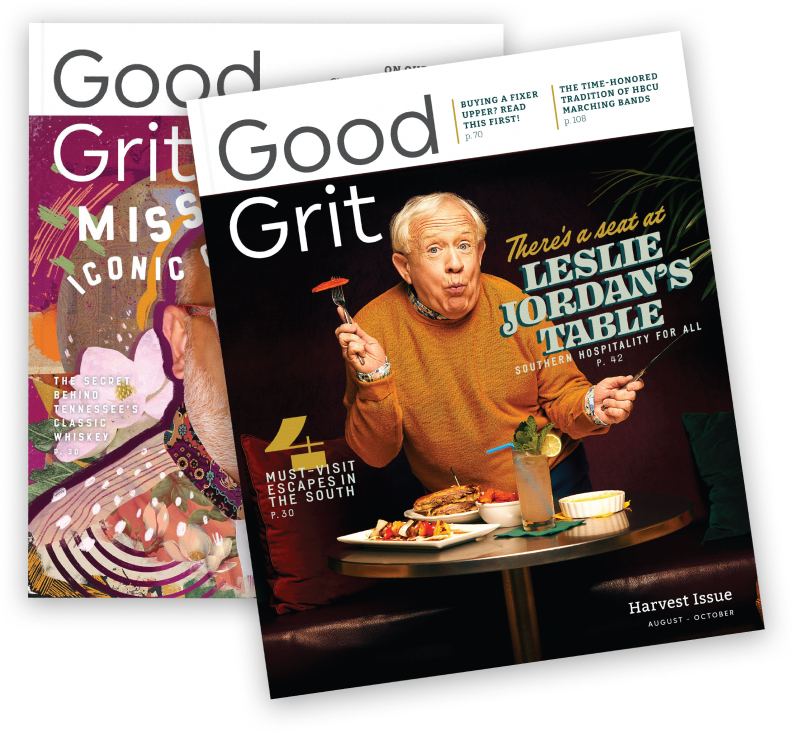
Good Grit Magazine's quarterly print edition explores Southern culture, connecting with over 300,000 readers who love to celebrate the South's enduring spirit. Each issue is a thoughtfully put-together collection of stories, people, and places that truly capture the authentic South.


Get ready to be captivated by tales of resilient Southern spirit, whether you were born and raised here or have just found your home in the South. From treasured family recipes handed down through the years to groundbreaking innovations shaping our future, our pages are brimming with excitement and inspiration. We honor tradition while exploring fresh ideas, connecting generations and bridging cultural divides. Good Grit Magazine is your gateway to the heart and soul of the South.

LEARN MORE

More Words From Good Grit

By Samantha Southerland July 24, 2026
I once watched a room full of grown adults spend forty-five minutes arguing about a shade of blue. Forty-five minutes. Not healthcare. Not the economy. Not anything with actual stakes. Blue. Was it navy? Midnight? Slate? Trustworthy? Sophisticated? Did it feel approachable enough? Too approachable? Not approachable in the right way? Y'all. I sat there and watched what can only be described as a hostage negotiation between fully employed professionals and a color wheel. And I couldn't help but wonder — when exactly did we decide our logo was responsible for doing all the heavy lifting? Business owners love their logos. I get it. A logo feels real. You can see it. Put it on a shirt. Debate it endlessly in a conference room while someone refills the coffee. What a logo cannot do — not ever, not once in the history of business — is create trust. That's your job. A human job. Not a design job. Nobody wraps around the Chick-fil-A drive-thru because of a cartoon chicken. Nobody slaps a Nike swoosh on their kid's backpack because of the font. Those logos represent trust that was earned a thousand times over before the logo ever got involved. A logo is a shortcut to a reputation you already built. That's it. And yet. I have watched companies spend months — months — perfecting a logo while their customer experience is out here completely unsupervised. The phone isn't answered. The website hasn't been touched since 2019. Nobody followed up on the proposal. The email sat in someone's inbox for two weeks. But the blue? The blue is perfect. Here's the truth: customers don't fall in love with logos. They fall in love with how you made them feel. The logo just shows up at the end and takes all the credit. Kind of like the attractive friend who barely touched the group project but somehow gets an A and everyone's grateful they came. For the record — we do logos. We love logos. A great logo is a beautiful thing. We just refuse to hand you one without making sure the rest of the house is in order first. Because a great logo deserves a great reputation to stand behind it. And that's the part we really care about getting right.  Good Grit helps businesses build brands that actually earn the logo. Let's talk.
By Samantha Southerland July 8, 2026
I was standing in line at a coffee shop last week, minding my business, when the phone behind the counter started ringing. The woman at the register stared at it. Her coworker stared at it. They looked at each other. They looked at the phone. They looked back at each other. It rang five times and died. Nobody answered. Nobody moved. Nobody seemed remotely bothered. And I'm standing there holding my cup thinking — y'all. The person on the other end might have wanted to order coffee for fifty people. Might have been asking about catering. Might have just wanted to know if they're open on Sunday. We'll never know. Because nobody picked up. And I couldn't help but wonder — how many businesses are out here spending thousands of dollars just to get someone to call, and then just... don't answer? Here's the thing. I talk to business owners all day long. Smart ones. Ones who have built something real and are ready to grow. And when they sit down with me, they know exactly what they want. More social media. A better website. Google ads. A video. An email that actually makes people click. Not a single one has ever looked me in the eye and said "Samantha, we need to answer our phone." And yet. Companies will spend $10,000 on a website. $15,000 on ads. $20,000 on a brand video that honestly slaps — and then take three days to call somebody back. Like customers in 2026 are over there cross-stitching and patiently waiting. They are not. We live in a world where people track their Amazon package like it's a missing person. Two-day shipping feels offensive now. And somehow we expect those same humans to sit tight while we get around to returning their inquiry? Not gonna lie. That's the actual problem. The marketing isn't broken. Your customer journey is. Because here's what marketing actually does — it gets somebody curious enough to reach out. That's it. Everything that happens after that phone rings, after that email lands, after that DM comes in? That's on you. Which means sometimes the highest-return thing you can do for your business isn't run another ad. It's pick up the phone.
By Samantha Southerland June 24, 2026
Marketing gets people to your front door. Everything else determines whether they stay.
By Samantha Southerland May 8, 2026
I used to think business started with a plan. That’s actually a lie. It starts with a feeling.
By Laura Quick April 28, 2026
This past weekend, I found myself at the South Walton Beaches Wine & Food Festival—a tented maze of brands, bottles, and people all trying to do the same thing: Get noticed. Rows and rows of wine from across the country and around the world, each offering a tiny pour and a quick pitch. One sip. That’s all you get. It made me think—this is what the marketplace feels like. You’re lined up next to competitors who look a lot like you. You get one shot at attention. One moment to make someone care. And somehow, by the end of the weekend, I walked away wit h three cases I was willing to wait in line for.
By Laura Quick February 17, 2026
Smart Leaders Ask These 3 Questions Before Cutting Their Marketing Budget
By Laura Quick May 27, 2025
If you’re a woman in the workplace, chances are you’ve felt the pull of people-pleasing. Early in your career, it can feel like a survival instinct—wanting to get things right, be liked, and prove yourself. We walk in with goals for where we want to be in the future, whether within our current organization or across our career as a whole. But what happens when people-pleasing stops being a stepping stone and starts becoming a roadblock? The reality is this: People-pleasing can keep you stuck.  It can create a perception that you’re someone who will go with the flow of whoever is in the room rather than someone who has a clear perspective. Over time, this can lead to a lack of respect from colleagues and leadership. Instead of being seen as a strategic thinker, you may be overlooked for leadership roles because decision-makers don’t see you as someone who brings innovation, challenges ideas, or solves problems. Why Authenticity Is a Career Advantage Leaning into authenticity at work doesn’t mean being difficult or contrarian—it means: Understanding your own perspective and being prepared to articulate it clearly. Recognizing that you won’t always agree with everyone—and that’s not only okay, it’s healthy. Knowing that agreeability in a thriving organization only works when it’s authentic. If you’re agreeing just to avoid conflict, you’re not actually contributing to the growth of your department or organization. Worse, you may be impeding progress without realizing it. People-pleasing can unintentionally send the message that you’re not a problem solver, that you’re unwilling to challenge inefficiencies, or that you don’t have the vision to push an organization forward. And when leaders don’t see you as someone who questions, innovates, or refines processes, they may not see you as someone who is ready for the next level in your career. Your Permission Slip to Lead with Authenticity If you’ve been playing small and waiting for permission to speak up, consider this your sign: Lean into authenticity. Use your voice. Articulate solutions to problems you see. Learn the skill of discerning when and how to disagree for the overall health of your company, your team, and your own career growth. The most successful women I know aren’t the ones who agree with everyone—they’re the ones who know when to challenge, when to offer a fresh perspective, and when to confidently advocate for what they believe will move the organization forward. So here’s your permission slip: You don’t have to be the most agreeable person in the room to be the most respected. You just have to be willing to show up as the leader you already are.
By Haley Chambers September 5, 2024
At Good Grit, one of our core values is being proactive communicators. But what does that really mean, and how do we live it out?
By Laura Quick August 16, 2024
Audit workshops are one of my favorite team exercises, and I've been facilitating them for over a decade. At Good Grit, we approach each client as an expert in their field, positioning ourselves as learners at the start of our partnership. My role initially is to listen and ask questions, fostering an interactive environment with whiteboards and dry erase markers for all participants. The goal of these sessions is to uncover productivity and revenue roadblocks and identify where confusion may exist within the organization. This confusion often translates externally, affecting client relations and clarity.
By Laura Quick May 2, 2024
Just as the pandemic had us taking to our individual home offices—which for many of us meant kitchen tables or coffee tables—our office implemented two meetings per week. Attendance was ALWAYS required unless they were dead or on vacation. Dramatic? Maybe. But keeping a team together when we were all navigating the unknown of a pandemic—and on some level worrying about making it as a company—well, it felt like the right requirement. More than two years later, we are still having two meetings per week—both still with required attendance (unless of course you are dead or on vacation). The kick off meeting always happens on Monday morning. The purpose of this meeting is strategy—we are diving into what we finished lined last week, and what is on deck for this week. It ranges from 60-90 minutes, but normally runs just around one hour. Our internal traffic manager runs this meeting, and we prioritize based on biggest projects due that week. On Fridays though, things look different. We have a morning meeting that is just about checking in. Typically we watch a TED Talk during the week, and we discuss what we learned from it or how it challenged us—but then each teammate checks in. The epiphany I had during the pandemic was what my team REALLY needed from me: consistency. As an entrepreneur who has had to grow and earn the title CEO, consistency is not natural. I have made it a habit over the last several years to hire incredible humans that are all leaders. I know how rare it is to have a team full of people who are self-motivated, solution-oriented, make-it-happen humans. I know it’s rare because I’ve worked on many teams where that wasn’t the case. Truly, I think this exact team has grown into those characteristics because they feel so supported. Interdependent, and yet autonomous. Launching two meetings each week is something I think we will do forever. And listen—I’m the CEO that HATES meetings about meetings, or meetings that totally could have been a text—but these meetings are purposeful and create incredible momentum and impact. Today I wanted to focus on our Friday meeting, which is all about CULTURE. And if you are a leader, you already know this—culture is in the top three currencies your employees or future employees are using to measure whether they want to work with you or continue working for you. As leaders who are leading other leaders who are leading teams of people vital to our organization, we need to be fluent in what creates a culture worth staying in for the long haul. Here are the two most powerful culture building questions leaders can ask their teams: 1. What did you/your team accomplish that is worth celebrating? Encouraging our teams to see even the smallest victories is so important. If we don’t count the small wins, we could end up missing the really big ones too. By asking this question consistently, your employees will know it’s coming—and they will want to have something to share WORTH celebrating. I love this question because it forces all of us to focus on what went well, what problems we actually solved, and how even a small thing moved the needle. When we focus on these positive wins, we are reenforcing a culture of not just seeing it in yourself or your team, but in one another. As a CEO, it is incredible insight hearing how my leadership team spent their week by how they articulate their wins. 2. Who on our team is your hero this week, and why? Who is the Most Valuable Player to you and why? I cannot tell you how this has enriched our company culture. They know this question is coming every week, and it never gets old. Because it is NORMAL in our company to brag on a teammate for kicking butt, pitching in, hitting tight deadlines, and a myriad of other things. When your team becomes accustomed to finding the gold in the people they work with and calling it out, MAGIC HAPPENS. I can’t give you a real statistic on what percentage of change you will have if you consistently, weekly, ask these two powerful questions, but I promise it’s significant. The hardest part will be making space for a meeting dedicated just to connection. The second hardest part will be YOU, the leader, showing up, leading the charge, and participating. Challenge yourself to try it for a month, and then email me and let me know how it goes! I would love to hear from you!
Show More